
What is commissioning?
The purpose of this article is to define commissioning and to describe each stage of the process. We also outline the opportunities for engagement at each stage and the support C3SC can offer through the stages of the commissioning process.
Where does the third sector fit into Commissioning?
The third sector is a powerful and important part of the commissioning process. As a sector, it has two main functions; the first is to use its knowledge of the need to influence what services should look like. Many charities and grass roots organisations will know exactly what would best serve the communities they work in. Secondly, many third sector organisations are also providers of solutions in their own right – they are commissioned to deliver services that meet the needs of the community.
The Commissioning Framework
Commissioning is quite simply the process the public sector uses to decide which service or products to buy in or deliver itself, to respond to the needs of local people. It involves making decisions about the capacity, location, cost and quality of services, as well as who will deliver them and how.
The Commissioning Cycle
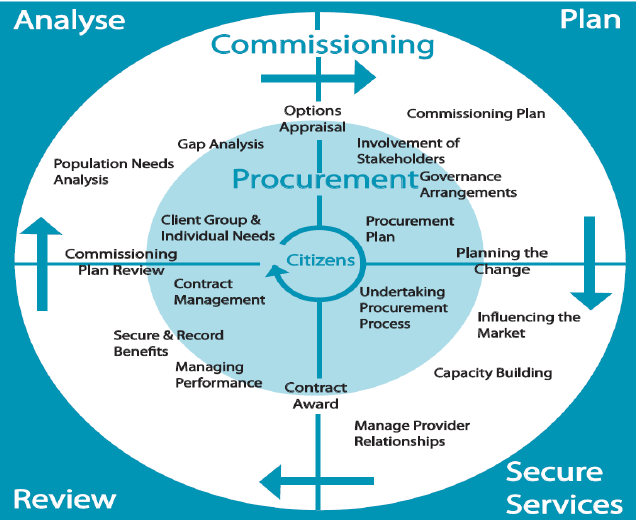
Analysis: this stage aims to define the change that is needed by defining the need – the problem that needs solving – and the desired outcome.
Planning: involves designing a range of options that will work to address the issues identified against the desired outcome.
Securing services: is the process of funding the option or range of options agreed to deliver the defined outcome via an agreed funding method – grant funding, contracting, etc.
Reviewing: entails evaluating the chosen option(s) to see what has worked well and what can be improved further.
The Commissioning Cycle is frequently illustrated diagrammatically – see below. The process was originally developed by the Institute of Public Care and has been adopted by Welsh Government, local authorities and the health service.
The diagram below sets out the steps that make up the commissioning cycle. All four steps are equally important. There is a focus on identifying needs by agencies using this model, together with an underlying principle that there will be ongoing dialogue with service users, carers, and providers, including third sector organisations.
The third sector’s contribution to each stage of the commissioning cycle:
It is important for the third sector to be involved at each stage of the cycle. We set out the opportunities for engagement and how C3SC can support your involvement below…
At the ‘Analyse’ stage you can:
- Contribute to needs analysis, the identification of appropriate outcomes and service mapping;
- Provide feedback on the vision, needs assessment, accuracy of gap analysis;
- Share models of best practice and innovation;
- Contribute to the planning and delivery of stakeholder events and advocate for harder-to-reach groups.
C3SC will:
- Push for meaningful involvement of the third sector in the development of public sector commissioning plans – for example, we sit on Cardiff Council’s Joint Commissioning Framework Project Board, advocating for the sector at all times;
- Provide you with development support through our team of Third Sector Officers (TSOs) to help you review the information you gather and how you can best present it as robust business intelligence;
- Deliver Monitoring and Evaluation training and Results Based Accountability (RBA) training;
- Hold consultation events and viewpoint sessions;
- Always send the outcomes of our consultations and events to the relevant service planners.
At the ‘Plan’ stage you can:
• Provide feedback on the priorities set out in commissioning plans;
• Contribute to the market plan – what is your knowledge of the market?
• Contribute to developing service specifications, including soft outcomes and social benefits;
• Facilitate service user involvement in the development of service specifications;
• Contribute to developing funding and procurement plans, for example, ‘make or buy decisions’ (providing a service in-house or buying the service in, including grant or contract processes and terms);
- Start to plan and develop consortia or new partnership arrangements.
C3SC will:
- Hold consultation events and viewpoint sessions so that the sector has a strong voice in the development of commissioning plans;
- Provide support through our Third Sector Representative Partnership Council to feed back to the relevant strategic partnerships on whether or not new commissioning plans and third sector involvement have been successful;
- Continue to be involved in the development of the UHB’s Service Pathway Specification – which sets out service specifications for key service areas within health. TSOs can help you identify where you can continue to input into these service areas – email [email protected] to find out more;
- Continue to lobby for grants as a key part of the commissioning process – for capacity building, delivery and market shaping (market shaping means helping commissioners understand what services are available to commission);
- Provide opportunities and support for the development of consortia and partnerships.
At the ‘Secure Services’ stage you can:
- Develop tenders to bid for contracts or make a grant application, as relevant;
- Contribute to advertising funding / tendering opportunities;
- Suggest how monitoring and performance can be improved;
- Participate in tender evaluations;
- Suggest joint training / secondments / job exchanges with commissioners.
C3SC will:
- Provide training in completing funding applications and developing tenders to bid for contracts;
- Provide quality funding advice, including how to develop a full cost recovery budget (contact your local TSO);
- Provide one-to-one support on planning for outcomes, including ‘Outcomes Planning’ training – contact us for details;
- Run regular grant application surgeries (keep an eye on our website for more details).
At the ‘Review’ stage you can:
- Contribute to discussion on service performance;
- Contribute to ideas on monitoring outcomes;
- Advocate for wider stakeholder involvement;
- Contribute to the review of services;
- Contribute to the evaluation of overall commissioning strategies;
- Contribute to local scrutiny arrangements.
C3SC will:
- Facilitate third sector involvement in the review of services;
- Provide training on using RBA as a performance management tool;
- Advocate the ten National Principles of Public Engagement at all levels and use them within our own participation techniques workshops – which we can run for you at any time – email [email protected] to find out more;
- Recruit and support Third Sector Representatives on Cardiff Partnership Board scrutiny arrangements;
- Keep the Compact in mind during all these activities.
Other useful information
- Take a look at Cardiff Council’s procurement web page.
- Sell2Wales is an initiative from the Welsh Government helping SMEs to work successfully with public sector clients. Since inception, Sell2Wales has advertised over £5 billion of notices and, with a growing number of public sector bodies advertising through it, tenders are more accessible. This site allows you to promote your company, contact registered public sector organisations, seek advice and much, much more.
- Value Wales has devised the Procurement Route Planner (PRP) that seeks to promote a structured, step-by-step approach and encourage a consistent best practice to procurement throughout the Welsh public sector.


